

Students searching for diagnostic cardiac sonography usually want a clear answer: what is the next step following training? The simple answer is that graduates strive toward professions such as cardiac sonographer, echocardiographer, ultrasound technologist, imaging lab assistant or future supervisor or instructor depending on accreditation, registration, clinical confidence and experience.
A strong diagnostic cardiac sonography program should prepare students for that full pathway, not simply for classroom completion. At Pharma Medical Science College of Canada, the accredited cardiac sonography program is listed as 78 weeks of instructor-led full-time training and clinical practice, with a 22-week practicum in local clinics and hospitals.
Key Takeaway
After diagnostic cardiac sonography training, graduates move through clinical practice, exam preparation, registration requirements, and job search before working independently in hospitals, cardiology clinics, diagnostic centres, or private echo labs.
TL;DR: The career path after diagnostic cardiac sonography training
After cardiac sonography training, the typical pathway is training completion, scanning practice, clinical placement, exam preparation, provincial registration where required, and then applications to hospitals, cardiology departments, diagnostic imaging clinics, private echo labs, and outpatient healthcare settings.
The practical goal is simple: get good at echocardiographic images, measurements, patient interactions, knowledge of ECG, and reporting support. Employers aren’t only seeing if you graduated school. They want proof that you can work securely, speak properly and get better with criticism.
For students comparing healthcare programs in Canada, cardiac sonography is a specialized, technology-driven route. It suits people who want direct patient contact, diagnostic responsibility, and a focused connection to heart structure and function.
Why Pharma Medical can speak to the student-to-professional transition

Pharma Medical’s diagnostic cardiac sonography program covers cardiovascular anatomy and pathology, cross-sectional anatomy, instrumentation principles, echocardiography theory and scanning, ECG, patient care, ethics, and professional conduct. These are the subjects that connect technical scanning with real clinical judgment.
That combination important. A student may comprehend cardiac anatomy in class, but the job demands a different level of skill: situating a patient, adapting to body habitus, staying calm during a tough scan, checking measurements, recording accurately and knowing when to seek for help.
A useful example comes from Pharma Medical’s visible graduate testimonial for Diagnostic Cardiac Sonography, where Nazish Mujeeb describes clinical-environment exposure and development of image acquisition, interpretation, measurement, analytical, theoretical, and reporting skills. That is the real bridge from student to professional.
The real career map: from training room to registered healthcare professional
You have a milestone to graduate The typical career ladder comprises training, clinical practice, exam prep, credentialing, registration, a targeted job search and ultimately the transition from supervised confidence to independent performance.
Students in Ontario should be aware of professional registration requirements. CMRITO’s brief remarks Diagnostic medical sonography professionals must be registered in their specialty to be able to legally practise. Applicants are required to have approved training and applicable Sonography Canada tests.
Complete training and clinical practice
Build confidence in echocardiography theory, ECG awareness, scanning technique, patient care, and clinical workflow.
Prepare for credentialing
Track exam requirements, documents, references, deadlines, and provincial registration expectations before graduation.
Apply with competency proof
Use clinical examples, scanning skills, patient-care experience, and supervisor feedback to support job applications.
Step 1: Build core scanning competence
Scanning is not button-pushing. It is diagnostic information gathering.
Students need to have multiple practice opportunities to improve echo image quality, patient positioning, understanding of cardiac anatomy, correlation of ECG, picture optimization and measurement accuracy. The small things matter. The utility of the final research for the interpreting physician might be affected by precise image labelling, checking for rhythm, and repeating a weak view.
Step 2: Prepare for exams and registration early
Credentialing planning needs to be initiated before graduation. Students are responsible for monitoring exam requirements, time frames, identity, transcripts, clinical records, references and norms of professional conduct.
This is the place where organized students usually de-stress. Keep your documents in one folder. Maintain a log of clinical experience. Ask teachers what proof employers could want following interviews.
Step 3: Turn clinical placement into employable proof
Clinical placement can be the best part of a new grad’s CV. Instead of “completed practicum,” add patient care scenarios, scan types watched or aided with, protocols conducted, image quality improvements and feedback from supervisors.
Pharma Medical’s program page states that the college arranges co-op practice in clinics or hospitals for 22 weeks to help students gain real-world experience and prepare for a future job search. Students should treat that period like a professional portfolio, not only a placement requirement.
Career settings after cardiac sonography training: which path fits you?
Cardiac sonography graduates may pursue opportunities in hospitals, cardiology clinics, diagnostic centres, private echo labs, and related imaging environments. Pharma Medical lists career opportunities in community and teaching hospitals, cardiology and diagnostic centres or clinics, and medical ultrasound equipment or device settings.
| Career setting | What students may experience | Best fit for |
|---|---|---|
| Hospitals | Broader case variety, acute-care workflows, team communication, complex patients. | Students who want variety, mentorship, and exposure to diverse cardiac conditions. |
| Cardiology clinics | Focused echo workflow, outpatient testing, direct cardiology environment. | Students who want concentrated cardiac imaging experience. |
| Diagnostic imaging centres | High scan volume, structured schedules, repeated protocol practice. | Students who want workflow consistency and repetition. |
| Education or supervision later | Training support, quality review, leadership, student mentoring. | Experienced sonographers who enjoy teaching and team development. |
Hospitals may expose new professionals to a greater variety of cardiac patients, acute-care workflows, and interprofessional communication. Focused echo scheduling, high repetition and scan volume, and consistent outpatient rhythm are available in private clinics.
There is no better or worse setting. It varies on mentorship, patient complexity, access to equipment, scheduling needs, and how much help a new graduate requires during the first year.
For deeper program research, students can review Pharma Medical’s guide to diagnostic cardiac sonography careers and its article on the best cardiac sonography program before comparing training options.
What employers look for beyond the diploma
Employers want evidence of readiness. That means scanning consistency, patient-care professionalism, documentation accuracy, ECG awareness, confidence with echo protocols, and a willingness to improve.
The better new grad resume is more likely to have proof of competency based. “used transthoracic echo workflow” “acquired standard cardiac views” “prepared patients for echocardiography exams” “applied ECG awareness during scanning” or “improved measurement consistency with feedback.”
Students can also boost their interview replies with real clinical situations. Tell me about a time you had to reposition a patient, enhance an image, deal with a worried patient, or were corrected by a supervisor.
78 weeks
Instructor-led full-time training and clinical practice at Pharma Medical.
22 weeks
Local clinic and hospital practicum listed for the program.
$41/hr
Median Ontario cardiac sonographer wage noted in the content brief.
The Ontario Job Bank shows wages for cardiac sonographers were in the $35.00 to $48.08 per hour range with a median of $41.00 and good prospects in the Toronto area. Use that as motivation, but don’t pick the field based on compensation alone. The profession requires physical stamina, patience, hand-eye coordination and comfort with diagnostic responsibility.
How diagnostic cardiac sonography compares with broader healthcare programs in Canada
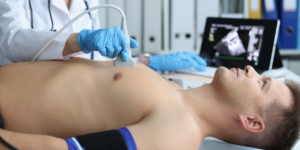
Diagnostic cardiac sonography is a focused imaging pathway. It is different from general healthcare programs because it centres on echocardiography, cardiovascular anatomy, ultrasound physics, ECG awareness, patient care, and cardiac image acquisition.
If you want administrative healthcare, wide patient assistance, or non-imaging responsibilities, you might want to consider an alternative path. If you’re a student who likes technology, anatomy, exact measurements and diagnostic work with patients, you may find cardiac sonography appealing.
Pharma Medical’s articles on what you’ll learn in cardiac sonography training and diagnostic cardiac sonography in Canada can help students compare the academic and practical expectations before applying.
The first is not obvious: the top pupils are not necessarily the fastest memorizers. Good sonography students are often observant. They care about image quality, patient comfort, slight measurement errors and workflow details. That practice typically turns into employability.
The first 90 days after graduation: a practical career launch plan
The first 90 days need to be structured. Graduates should arrange papers, prepare for examinations, develop a competency-based resume, create job alerts, request references and continue to examine scanning processes.
Weeks 1 to 2: Organize documents and credentialing requirements
Transcripts, clinical records, identity, vaccinations or placement documents, references, exam information and registration details. Waiting for a job posting to ask for proof can delay applications.
Weeks 3 to 6: Build a cardiac-sonography resume around competencies
Write resume bullets around echo protocols, patient care, ECG familiarity, image acquisition, measurements, reporting support, and professional behaviour. Maintain specific terminology. “A hiring manager should see what you really can do.”
Students still comparing programs can use Pharma Medical’s guide on how to choose the right cardiac sonography program and review the Nazish Mujeeb graduate story for a practical view of the student experience.
Weeks 7 to 12: Apply strategically and keep learning
Target hospitals, cardiology clinics, diagnostic imaging centres, private echo labs and appropriate job boards. Keep on reviewing scanning concepts while looking for a job. Confidence goes away when you stop practicing.
Pharma Medical’s article on hands-on diagnostic cardiac sonography training in Canada is a useful reminder that practical exposure is a major part of career readiness.
Explore diagnostic cardiac sonography training in Toronto
Ask Pharma Medical how its cardiac ultrasound diploma can support your path from student to healthcare professional.
Contact UsReady to move from interest to a career plan?
Diagnostic cardiac sonography training can lead to meaningful healthcare work, but the pathway works best when students understand the full route: classroom learning, lab skills, clinical experience, exams, registration, and strategic job search.
Pharma Medical Science College of Canada gives students a focused cardiac ultrasound pathway with instructor-led training, clinical practice, and preparation for the Sonography Canada national registry examination. If you’re ready to explore the next step, contact Pharma Medical and ask how the program can support your career goals.
FAQs:
1. What can you do after diagnostic cardiac sonography training?
After training, graduates may pursue roles such as cardiac sonographer, echocardiographer, ultrasound technologist, imaging lab assistant, or eventually supervisor or instructor. The exact pathway depends on credentialing, registration, clinical experience, and employer requirements.
2. Do cardiac sonography graduates need registration in Ontario?
Yes, students in Ontario should understand CMRITO registration expectations before practising independently. The pathway generally involves approved training, relevant examinations, and registration in the appropriate specialty.
3. Where can cardiac sonographers work?
Cardiac sonographers may work in hospitals, cardiology departments, diagnostic imaging clinics, private echo labs, outpatient healthcare settings, and related medical ultrasound environments.
4. What skills do employers look for in new cardiac sonography graduates?
Employers usually look for scanning consistency, patient-care professionalism, ECG awareness, accurate measurements, documentation habits, understanding of echo protocols, and openness to feedback.
5. How can students turn clinical placement into job-search proof?
Students can document scan types, patient-care examples, image-quality improvements, supervisor feedback, protocols practised, and specific skills developed during placement.
6. Is diagnostic cardiac sonography different from broader healthcare programs in Canada?
Yes. Diagnostic cardiac sonography is a specialized imaging pathway focused on echocardiography, heart structure and function, ultrasound physics, ECG, and patient-facing diagnostic support.