How Much Do Medical Health Care Courses and Diplomas in Canada Typically Cost, Including Tuition Fees?

Feature Image

Canada holds a strong reputation for its healthcare education and medical health programs. Each year, students arrive from around the globe, drawn by the country’s high academic standards, strong clinical training, and career opportunities in the health sector. With rising demand for professionals in nursing, pharmacy, lab technology, and personal care, healthcare training in Canada continues to expand.

When choosing from the many healthcare courses in Canada, students, parents, and advisors often ask: What does it actually cost to study these programs? This guide breaks down everything—from tuition fees and textbooks to housing and program comparisons. Whether you’re considering online healthcare programs, certifications, or full-time diplomas, knowing the complete cost helps with planning and decision-making.

Key Factors That Influence Medical and Health Care Program Costs
Key Factors That Influence Medical and Health Care Program Costs

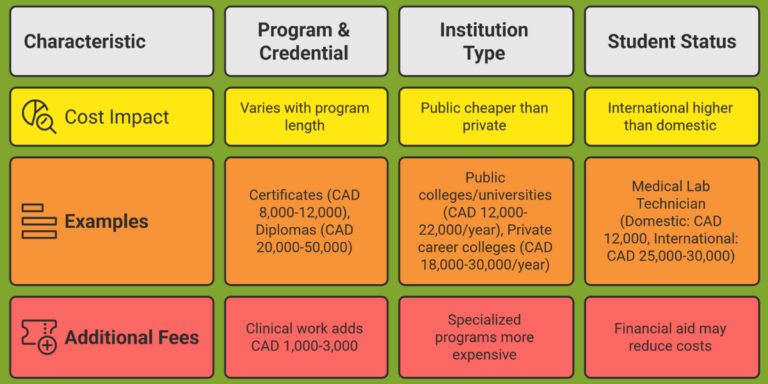
When considering the cost of medical courses in Canada, several factors contribute to the significant price differences between programs. Tuition and other expenses can change depending on where, what, and how you study.

Type of Program and Credential

The kind of credential has a big impact on cost. Short-term certificate programs are quicker and less expensive to complete than longer diploma or degree options. Here’s a breakdown of average program costs by credential type:

  • Medical Assistant Course / Pharmacy Assistant Certificate Course (under 1 year): CAD 8,000 – 12,000 total
  • Diploma in Practical Nursing (2 years): CAD 20,000 – 50,000 total
  • Diagnostic Medical Sonography Diploma Program (2 years): CAD 25,000 – 50,000 total
  • Physiotherapist Assistant & Occupational Therapist Assistant Diploma: CAD 12,000 – 22,000
  • Diploma in Healthcare Management: CAD 15,000 – 25,000

Programs like Physiotherapist Assistant & Occupational Therapist Assistant, or a Diploma in Healthcare Management, often include clinical work, adding CAD 1,000 – 3,000 in lab and practicum fees to the total expense.

Note: Tuition estimates listed here can differ based on delivery mode, program updates, and local policies. Always verify with your chosen institution.

Type of Institution (Public vs. Private)

Where you study matters. Public colleges and universities usually have lower tuition rates than private career schools. Here is a breakdown of average tuition costs by institution type:

  • Public Colleges/Universities: CAD 12,000 – 22,000 per year
  • Private Career Colleges: CAD 18,000 – 30,000 per year
  • Specialized Private Programs (e.g., Medical Esthetics, Acupuncture): CAD 25,000 – 40,000 total program cost

Private institutions may offer fast-track or niche programs like Medical Esthetics Diploma Programs or Acupuncture Diploma Training Programs, which tend to be more expensive due to specialized training and shorter durations.

Note: Public and private college fees are influenced by program format and funding structures. Check institutional websites for current rates.

Domestic vs. International Student Tuition

One of the biggest pricing differences lies between domestic and international students. International students often pay one and a half to three times more than Canadian citizens or residents. Here is a breakdown of sample tuition costs by student type:

Medical Laboratory Technician Training Program

  • Domestic: CAD 12,000
  • International: CAD 25,000–30,000

Registered Massage Therapist Program

  • Domestic: CAD 15,000–20,000
  • International: CAD 25,000–35,000

Pharmacy Technician Diploma

  • Domestic: CAD 15,000–18,000
  • International: CAD 25,000–32,000

Some institutions offer financial support, scholarships, or tailored entry pathways to help ease the cost for international learners.

Note: International tuition policies are subject to frequent changes. For precise figures, consult the admissions department of each school.

Average Tuition Costs for Medical and Health Care Diplomas & Certificates

Average Tuition Costs for Medical and Health Care Diplomas & Certificates

Tuition costs can vary widely between programs. Here’s a breakdown of typical fees for some of the most sought-after health care courses in Canada.

General Cost Estimates

  • Undergraduate diploma programs: CAD 15,000 to 36,000 per year
  • Health Care Assistant certificate programs: Free in select provinces or up to CAD 9,518 annually
  • Diploma in Practical Nursing: CAD 10,000 to 40,000 per year
  • Pharmacy Technician Diploma: Around CAD 17,049 per year
  • Medical Laboratory Technician Training Program: CAD 9,575 to 18,825 per year

Total costs over the course of study may range from CAD 20,000 to 80,000, depending on program length and institution.

Note: These costs serve as broad guidelines. Confirm current fees directly with your intended college or program advisor.

Other In-Demand Medical Diploma Programs

  • Medical Assistant Course Cost: CAD 8,000 to 18,000 per year
  • Physiotherapist Assistant & Occupational Therapist Assistant: CAD 12,000 to 22,000 per year
  • Medical Office Administration Diploma Program: CAD 8,000 to 16,000 per year
  • Diagnostic Cardiac Sonography Diploma Program: CAD 20,000 to 25,000 per year
  • Diagnostic Medical Sonography Diploma Program: CAD 22,000 to 25,000 per year
  • Acupuncture Diploma Training Program: CAD 15,000 to 20,000 per year
  • Registered Massage Therapist Program: CAD 15,000 to 25,000 per year
  • Personal Support Worker Program: CAD 8,000 to 12,000 per year

These medical diploma programs for international students often include additional registration, lab, and administrative fees ranging from CAD 500 to 2,000.

Note: Fees can vary from year to year and depend on your province and chosen college. Refer to official sources for accurate data.

Online and Hybrid Healthcare Programs: Are They Cheaper?
Online and Hybrid Healthcare Programs: Are They Cheaper?

Online learning continues to gain popularity, offering increased flexibility and accessibility. For students considering online healthcare programs, affordability is another strong advantage.

Tuition Savings and Accessibility

Online healthcare programs often cost 10 to 30 percent less than traditional classroom-based programs. Here is a breakdown of typical savings:

  • In-person Medical Office Administration Diploma Program: CAD 15,000
  • Online version: CAD 10,000 – 12,000 → Savings: CAD 3,000 – 5,000
  • Relocation and commuting costs saved: CAD 5,000 – 10,000 annually
  • Total potential savings with online format: CAD 8,000 – 15,000 per year

For those balancing work or family, these programs are a practical way to lower healthcare costs in Canada.

Note: Online program pricing may vary by institution and access to resources. Please confirm with the program provider.

Popular Online Programs

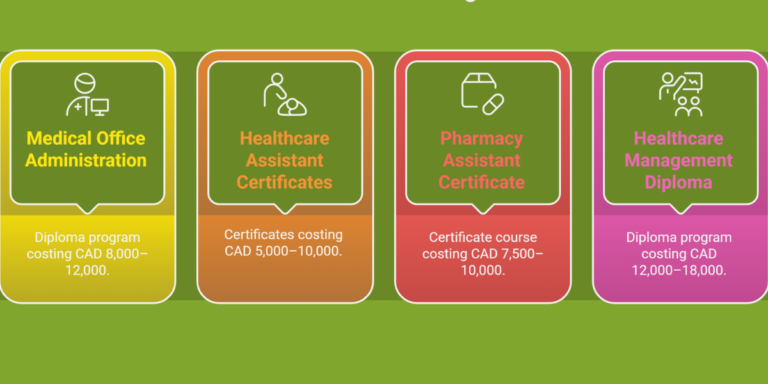
Some well-regarded online offerings include:

  • Medical Office Administration Diploma Program: CAD 8,000–12,000
  • Healthcare assistant certificates: CAD 5,000–10,000
  • Pharmacy Assistant Certificate Course: CAD 7,500–10,000
  • Diploma in Healthcare Management Fees: CAD 12,000–18,000

These programs match the curriculum and value of in-person courses while reducing costs and improving accessibility.

Note: Tuition amounts listed reflect commonly available ranges and may not include all fees. Always confirm with the online program provider.

Connect with Us for Details on the Medical Health Care Courses and Diplomas in Canada

Textbooks, Supplies, and Additional Expenses

Textbooks, Supplies, and Additional Expenses

Education expenses don’t stop at tuition. Supplies, textbooks, and practicum fees add to the cost of training in health care.

Textbook Costs in Canada

Students usually spend between CAD 800 and 1,500 per year on textbooks. Here is a breakdown of typical textbook expenses:

  • General textbooks for healthcare courses: CAD 100 – 200 each
  • Specialized texts for medical programs (e.g., sonography, esthetics): CAD 250 – 300 each
  • Annual textbook budget: CAD 800 – 1,500
  • Savings options: Used books, rental programs, or e-book versions

Courses like the Diagnostic Medical Sonography Diploma Program or the Medical Esthetics Diploma Program often require multiple specialized texts, which can increase the annual textbook budget significantly.

Note: Textbook prices are approximate and may vary by course edition and format. Check your course syllabus or college bookstore.

Equipment and Clinical Supplies

Programs such as the Medical Laboratory Technician Training Program or the Registered Massage Therapist Program often require tools like stethoscopes, scrubs, lab kits, and personal equipment. Here’s a breakdown of typical equipment and supply costs:

  • Stethoscope: CAD 80 – 150
  • Lab coat/scrubs: CAD 60 – 120
  • Medical/lab kits: CAD 100 – 250
  • Software or simulation tools (if applicable): CAD 50 – 200
  • Total estimated equipment cost per student: CAD 300 – 600

Some institutions include these items in tuition fees, while others require separate purchases by the student.

Note: Equipment costs vary based on program type and institutional requirements. Always request a materials list for up-to-date pricing.

Licensing and Practicum Fees

Many programs include unpaid clinical placements. These provide valuable experience but require students to plan for expenses while not earning income. Here’s a breakdown of typical practicum and licensing costs:

  • Living expenses during unpaid practicum: CAD 2,000 – 5,000 (depending on duration and location)
  • Certification exam fees: CAD 300 – 1,000 (varies by profession)
  • Travel to practicum sites (if off-campus): CAD 100 – 500
  • Uniforms or additional insurance (if required): CAD 50 – 200

These should all be considered as part of the total healthcare certification cost in Canada.

Note: Licensing and practicum-related costs depend on program structure and location. Consult your school for exact figures.

Living Expenses While Studying in Canada

Living Expenses While Studying in Canada

Living costs are a major consideration for students planning to attend medical health programs. From rent to transit, expenses can vary by city and lifestyle.

Monthly Living Costs

Most students need between CAD 900 and 1,500 per month to cover housing, food, transportation, phone, and personal expenses. Here’s a breakdown of typical monthly living costs:

  • Rent (Toronto/Vancouver): CAD 800 – 1,200
  • Rent (Winnipeg/Halifax or smaller cities): CAD 500 – 900
  • Food and groceries: CAD 300 – 500
  • Transit pass: CAD 80 – 120
  • Phone and internet: CAD 50 – 100
  • Personal/miscellaneous expenses: CAD 100 – 300

These figures may vary depending on lifestyle, housing choice, and city, but they help estimate monthly budgeting for students in Canada.

Total Annual Cost (Tuition + Living)

  • Domestic students: CAD 18,000 to 35,000 annually
  • International students: CAD 25,000 to 60,000 annually

When exploring affordable medical courses in Canada, it’s important to calculate the full cost of attendance, not just tuition. Including supplies, books, and housing gives a more accurate budget.

Average Cost of University Courses and Medical School in Canada

Average Cost of University Courses and Medical School in Canada

University degrees and medical school programs involve a different level of investment. These options are ideal for students pursuing licensed professional paths.

University Courses

Health-related university courses usually cost between CAD 500 and 1,500 each. Here’s a breakdown of associated costs:

  • Cost per course: CAD 500 – 1,500
  • Full-time semester tuition: CAD 6,000 – 12,000
  • Annual university tuition (two semesters): CAD 12,000 – 24,000
  • Additional lab/clinical fees (if applicable): CAD 300 – 1,000 per course

Classes with labs or clinical training tend to be more expensive. These courses serve as building blocks for many careers in medical health programs.

Average Tuition for Medical School in Canada

  • Domestic students: CAD 12,000 to 28,000 per year
  • International students: CAD 25,000 to 70,000 per year

Over four to five years, total tuition costs range from CAD 60,000 to 150,000 for domestic students and CAD 120,000 to 300,000 for international students. Additional living and exam costs apply.

Cost Comparisons by Province

Cost Comparisons by Province

Program costs and living expenses vary across Canadian provinces. Regional comparisons can help students choose a location that fits their budget.

Ontario and BC

Ontario and British Columbia offer a broad range of medical diploma programs for international students. Here’s a breakdown of typical costs in these provinces:

  • Tuition (per year): CAD 15,000 – 30,000
  • Rent (shared accommodation): CAD 800 – 1,200/month
  • Utilities and Internet: CAD 100 – 150/month
  • Groceries and food: CAD 300 – 500/month
  • Public transportation: CAD 100 – 150/month
  • Total estimated living expenses: CAD 1,200 – 1,800/month or CAD 14,400 – 21,600/year

Higher demand and urban cost of living contribute to elevated tuition and expenses in cities like Toronto and Vancouver.

Alberta and the Prairies

In Alberta, programs like Health Care Assistant certificate training are sometimes subsidized. Here’s a breakdown of typical costs in Alberta and the Prairie provinces:

  • Health Care Assistant Program Tuition: CAD 6,000 – 12,000 per year (may be subsidized)
  • Rent (shared or student housing): CAD 500 – 900/month
  • Utilities and Internet: CAD 80 – 120/month
  • Groceries and food: CAD 250 – 400/month
  • Transportation (public transit): CAD 70 – 110/month
  • Total estimated living expenses: CAD 800 – 1,100/month or CAD 9,600 – 13,200/year

Lower rent and cost of living in the Prairie provinces help reduce the overall Canadian healthcare program’s tuition burden.

Quebec and Atlantic Provinces

Quebec offers low tuition, especially in French-language institutions. Here’s a breakdown of typical education and living costs in Quebec and the Atlantic provinces:

  • Tuition (Quebec – domestic students): CAD 3,000 – 9,000/year
  • Tuition (Quebec – international students): CAD 10,000 – 17,000/year
  • Rent (shared or student housing): CAD 500 – 800/month
  • Utilities and Internet: CAD 80 – 120/month
  • Groceries and food: CAD 250 – 400/month
  • Transportation: CAD 60 – 100/month
  • Total estimated living expenses: CAD 900 – 1,200/month or CAD 10,800 – 14,400/year
  • Total annual cost (including tuition): CAD 18,000 – 28,000/year

The Atlantic provinces, such as Nova Scotia and New Brunswick, offer similar programs and costs, making them attractive for budget-conscious students.

Scholarships, Government Support, and Financial Aid

Scholarships, Government Support, and Financial Aid

Financial assistance makes education more accessible. Many students can reduce college healthcare fees in Canada through government or institutional support.

Canadian Financial Aid Options

Domestic students can apply for grants and loans through programs like OSAP, Alberta Student Aid, or StudentAid BC. Here’s a breakdown of typical financial support amounts:

  • OSAP (Ontario): Up to CAD 12,000 – 15,000/year depending on need and program
  • Alberta Student Aid: Up to CAD 10,000 – 13,300/year (loan and grant combined)
  • StudentAid BC: CAD 7,000 – 12,000/year
  • Eligible uses: Tuition, textbooks, and living expenses for programs like the Pharmacy Assistant Certificate Course and Medical Assistant Course

These funds often provide enough coverage for full tuition or a large portion of education-related costs.

Institutional Scholarships and Bursaries

Colleges often provide need-based and merit-based awards that help reduce education costs. Here’s a breakdown of typical scholarship amounts:

  • General scholarship range: CAD 500 – 5,000 per year
  • Medical Laboratory Technician Training Program scholarships: CAD 1,000 – 3,000
  • Nursing program scholarships: CAD 1,500 – 4,000
  • Pharmacy program scholarships: CAD 2,000 – 5,000

Students in high-demand fields like Medical Laboratory Technician Training Program, Nursing, or Pharmacy frequently qualify for additional funding, making these programs more accessible.

International Student Support

International students may qualify for entrance scholarships, bursaries, or work-study programs. Here’s a breakdown of common cost-saving opportunities:

  • Entrance scholarships: CAD 1,000 – 5,000/year depending on merit and institution
  • Bursaries (need-based): CAD 500 – 3,000/year
  • Work-study program earnings: CAD 3,000 – 6,000/year
  • Employer sponsorships or tuition reimbursement: CAD 2,000 – 10,000/year (based on agreements)

These supports can significantly reduce the financial burden of medical diploma programs for international students.

Are Healthcare Diplomas Worth the Investment?

Are Healthcare Diplomas Worth the Investment?

Healthcare diplomas in Canada offer excellent value for students looking to quickly enter a growing industry. These programs tend to be shorter and more affordable than full university degrees, yet they lead to strong job prospects and competitive salaries. Here’s a closer look at what makes them a worthwhile investment:

Job Placement Rates

Many diploma programs report employment rates of 80% or higher within 6 months of graduation. Fields such as Personal Support Work, Pharmacy Assistance, and Medical Lab Technology have steady demand across provinces.

Entry-Level Salary Ranges

Graduates of healthcare diploma programs can expect to earn between CAD 35,000 and CAD 55,000+ annually in their first job. For example:

  • Medical Office Administrators: CAD 38,000 – 48,000
  • Pharmacy Technicians: CAD 42,000 – 55,000
  • Diagnostic Medical Sonographers: CAD 55,000 – 75,000
  • Personal Support Workers: CAD 35,000 – 45,000
  • Physiotherapist & Occupational Therapist Assistants: CAD 38,000 – 52,000
  • Medical Laboratory Technicians: CAD 40,000 – 55,000
  • Medical Assistants: CAD 36,000 – 48,000
  • Registered Massage Therapists: CAD 45,000 – 60,000
  • Acupuncture Practitioners: CAD 45,000 – 65,000
  • Healthcare Management Assistants: CAD 50,000 – 70,000

Permanent Residency Opportunities

For international students, many programs qualify for post-graduation work permits (PGWP), helping students accumulate Canadian work experience. This can lead to permanent residency under programs like the Canadian Experience Class (CEC) or Provincial Nominee Programs (PNP).

Note: Salary ranges and job outcomes depend on location, employer demand, and specific program credentials. Check with program advisors or job boards for current opportunities.

Choosing the Right Program Based on Budget and Goals

Choosing the Right Program Based on Budget and Goals

Careful planning enables students to select programs that align with both their career and financial goals. It’s essential to consider both the long-term benefits and the initial costs.

Cost vs. Career Outcome

Programs like the Diagnostic Cardiac Sonography Diploma Program, Acupuncture Diploma Training Program, or Pharmacy Assistant Certificate Course require a larger financial investment but often lead to higher earnings and job stability. Graduates can expect entry-level salaries ranging from CAD 45,000 to 75,000 annually, depending on role and location.

Permanent Residency and Work Pathways

Many medical diploma programs for international students qualify for work permits and contribute toward permanent residency eligibility. These added benefits make certain programs more appealing despite higher tuition. Estimated costs may be recovered through full-time employment within 2–3 years post-graduation.

Parent, Advisor, and Professional Considerations

Parents and advisors can help students evaluate all costs, not just tuition. Planning tools, financial aid resources, and clear career goals make a difference when selecting from health care courses in Canada. A detailed budget spreadsheet is helpful for comparing schools, fees, supplies, and housing across multiple programs.

Why Choose Pharma-medical Science College of Canada for Your Healthcare Education?

Why Choose Pharma-medical Science College of Canada for Your Healthcare Education?

Pharma-Medical Science College of Canada offers comprehensive medical health programs with a focus on hands-on learning and industry-relevant skills. Programs meet the needs of the healthcare, pharmaceutical, and food sectors.

Our tuition is competitive, and many students qualify for assistance through OSAP, Second Career, and ODSP. These supports help us offer accessible healthcare education to a diverse student population.

We welcome learners from around the world and offer comprehensive support for medical diploma programs for international students. Our staff helps students navigate study permits, job training, and career placement.

Graduates from our college find employment across the healthcare and pharmaceutical fields. With expert instructors and practical labs, students gain the skills needed for immediate workforce entry. Many of our graduates secure employment within 3–6 months of completing their training.

Conclusion

The cost of medical courses in Canada varies based on program type, location, and student status. From certifications to full medical degrees, options exist for a wide range of goals and budgets.

By reviewing tuition, living expenses, and available aid, students can find affordable medical courses in Canada that support long-term success. Take time to research programs, connect with admissions advisors, and apply early to secure financial support and maximize career opportunities.

Start your healthcare journey with confidence at Pharma-medical Science College of Canada. Apply today and take advantage of our affordable, career-focused programs designed for local and international students.

Summary: Please note that the cost figures throughout this article are approximate and intended to serve as general guidelines. Actual fees may differ based on program duration, location, institution, and delivery method. Always check directly with the program provider for the most current and accurate information.


Connect with Us for Details on the Medical Health Care Courses and Diplomas in Canada

Want to Study a Medical Healthcare Course in Canada? Here Are Some Options to Consider

Feature Image

Understanding how long a pharmacy assistant course is in Canada is critical for planning your educational and career path. Whether you’re a student exploring healthcare roles, a professional considering a career switch, or a parent helping your child make informed decisions, knowing the timeline helps align expectations with goals.

The healthcare and pharmaceutical sectors are growing across the country, increasing demand for skilled pharmacy assistants. With strong job prospects, this role presents a stable and fulfilling career opportunity.

This article is ideal for students, working adults, career advisors, and parents looking to gain insight into training and job requirements in the pharmacy assistant field.

Why Study a Healthcare Course in Canada?

A woman sits at a desk with a laptop, focused on her studies in a healthcare course.

Canada maintains high academic standards and is known for its modern, technology-driven training environments. Students enrolling in a healthcare course in Canada benefit from rigorous curricula, hands-on experience, and exposure to cutting-edge healthcare practices.

The demand for healthcare professionals is growing steadily due to Canada’s aging population and the increasing focus on health and wellness. From rural areas to urban centers, qualified healthcare workers are in high demand, making it an excellent time to pursue a healthcare course in Canada.

Canada also provides attractive post-graduation pathways. Students completing a healthcare course in Canada can apply for Post-Graduation Work Permits (PGWP), which often lead to permanent residency opportunities.

Moreover, the country’s multicultural society and inclusive academic environment make it a welcoming destination for international students. Institutions provide support services to help students integrate and succeed.

Overview of Medical Healthcare Courses and Diplomas in Canada

Microscope and test tubes on a lab bench, representing medical and diagnostic training in healthcare programs.

Diagnostic and Clinical Programs

These programs train students to support physicians in diagnosis and treatment. Popular options include

Diagnostic Medical Sonography Program

The diagnostic medical sonography program is a practical healthcare course in Canada that trains students in ultrasound imaging of internal organs. This course opens career paths in hospitals, clinics, and private diagnostic facilities across the country.

Program Details:

  • Course Name: Diagnostic Medical Sonography Program
  • Program Length: 100 weeks of instructor-led full-time training and clinical practice
  • Practicum Duration: 32 weeks, Local Clinic and hospital
  • Application Fees: CAD $100
  • Tuition Fees: Approximately CAD $18,000 – $22,000 per year
  • IELTS Overall: 6.5 (No band less than 6.0)
  • TOEFL Overall: 88 (with no section below 20)
  • PTE Overall: 58

Diagnostic Cardiac Sonography Program

The diagnostic cardiac sonography program is a specialized healthcare course in Canada that trains students in heart imaging techniques. It prepares graduates for careers in cardiology departments of hospitals, clinics, and diagnostic centers.

Program Details:

  • Course Name: Diagnostic Cardiac Sonography Program
  • Program Length: 78 weeks of instructor-led full-time training and clinical practice
  • Practicum Duration: 22 weeks, Local Clinic and hospital
  • Application Fees: CAD $100
  • Tuition Fees: Approximately CAD $18,000 – $22,000 per year
  • IELTS Overall: 6.5 (No band less than 6.0)
  • TOEFL Overall: 88 (with no section below 20)
  • PTE Overall: 58

Medical Laboratory Technician Program:

The medical laboratory technician program is a foundational healthcare course in Canada that trains students to collect, handle, and analyze clinical samples. This course is ideal for those looking to work in medical labs, hospitals, and diagnostic centers.

Program Details:

  • Course Name: Medical Laboratory Technician Program
  • Program Length: 49 weeks of instructor-led full-time training with Co-op
  • Practicum Duration: 200 hours, Local Clinic and hospital co-op
  • Application Fees: CAD $100
  • Tuition Fees: Approximately CAD $14,000 – $18,000 per year
  • IELTS Overall: 6.0 (minimum 5.5 in each band)
  • TOEFL Overall: 80 (with no section below 18)
  • PTE Overall: 54

Physiotherapist Assistant and Occupational Therapist Assistant:

A group of doctors and nurses standing together in a hospital room, collaborating on patient care and treatment plans.

The physiotherapist assistant and occupational therapist assistant program is a practical healthcare course in Canada that equips students to support licensed therapists in rehab settings. Graduates work in hospitals, rehabilitation centers, and long-term care facilities.

Program Details:

  • Course Name: Physiotherapist Assistant Program, Occupational Therapist Assistant
  • Program Length: 48 weeks (1105 hours) instructor-led full-time training with Co-op
  • Practicum Duration: 320 hours in physiotherapy clinics and rehabilitation centers
  • Application Fees: CAD $100
  • Tuition Fees: Approximately CAD $16,000 – $20,000 per year
  • IELTS Overall: 6.5 (No band less than 6.0)
  • TOEFL Overall: 88 (with no section below 20)
  • PTE Overall: 58

Each of these is a valuable healthcare course in Canada, offering strong job prospects and professional development.

Patient and Personal Care Programs

These courses emphasize direct patient interaction and care:

Personal Support Worker Program  (PSW):

The personal support worker program (PSW) is a vital healthcare course in Canada that trains students to support elderly and disabled individuals with daily living activities in homes and long-term care settings.

Program Details:

  • Course Name: Personal Support Worker Program (PSW)
  • Program Length: 28 weeks (700 hours), instructor-led full-time training with co-op
  • Practicum Duration: 310 hours, co-op placement in both a long-term care facility and a community facility
  • Application Fees: CAD $100
  • Tuition Fees: Approximately CAD $12,000 – $16,000
  • IELTS Overall: 6.0 (minimum 5.5 in each band)
  • TOEFL Overall: 80 (with no section below 18)
  • PTE Overall: 54

Massage Therapy Diploma Program (RMT):

A group of women receiving therapeutic massages in a serene room, promoting relaxation and wellness.

The massage therapy diploma program is a specialized healthcare course in Canada designed to teach therapeutic massage techniques that aid in rehabilitation. Graduates are equipped to work in clinics, wellness centers, and physiotherapy practices.

Program Details:

  • Course Name: Massage Therapy Diploma Program (RMT)
  • Program Length: Full Time, 88 weeks of instructor-led full-time training
  • Clinic Practice: 315 hours at a college Massage clinic
  • Application Fees: CAD $100
  • Tuition Fees: Approximately CAD $14,000 – $18,000 per year
  • IELTS Overall: 6.0 (minimum 5.5 in each band)
  • TOEFL Overall: 80 (with no section below 18)
  • PTE Overall: 54

Acupuncture:

The acupuncture program is a holistic healthcare course in Canada designed to train students in traditional Eastern therapies. It’s in high demand across wellness centers, clinics, and integrative health practices.

Program Details:

  • Course Name: Acupuncture
  • Program Length: 89 weeks (2200 hours) instructor-led full-time training
  • Clinic Practice: 600 hours at a college Acupuncture clinic
  • Application Fees: CAD $100
  • Tuition Fees: Approximately CAD $15,000 – $20,000 per year
  • IELTS Overall: 6.5 (No band less than 6.0)
  • TOEFL Overall: 88 (with no section below 20)
  • PTE Overall: 58

Medical Esthetics Diploma:

The medical esthetician diploma is a specialized healthcare course in Canada that blends cosmetic procedures with clinical skincare knowledge. It prepares students for careers in dermatology clinics, medical spas, and wellness centers.

Program Details:

  • Course Name: Medical Esthetics Diploma
  • Program Length: 66 weeks (1350 hours) instructor-led full-time training
  • Clinic Practice: On College Medical and Esthetics clinic
  • Application Fees: CAD $100
  • Tuition Fees: Approximately CAD $13,000 – $17,000 per year
  • IELTS Overall: 6.0 (minimum 5.5 in each band)
  • TOEFL Overall: 80 (with no section below 18)
  • PTE Overall: 54

Choosing a healthcare course in Canada from this category is ideal for those passionate about patient care and holistic health.

Pharmacy and Healthcare Office Programs

Four students engaged in a discussion at a table, each using a laptop, focused on their pharmacy and healthcare studies.

For those interested in administrative or pharmaceutical roles:

Pharmacy Assistant:

The pharmacy assistant program is a practical healthcare course in Canada that prepares students to assist pharmacists with medication dispensing, inventory control, and patient communication in pharmacies and healthcare settings.

Program Details:

  • Course Name: Pharmacy Assistant Program
  • Program Length: 34 weeks (900 hours) instructor-led full-time training with Co-op
  • Practicum Duration: 6 weeks, for a total of 240 hours
  • Application Fees: CAD $100
  • Tuition Fees: Approximately CAD $13,000 – $16,000
  • IELTS Overall: 6.0 (minimum 5.5 in each band)
  • TOEFL Overall: 80 (with no section below 18)
  • PTE Overall: 54

Medical Office Administration Diploma Program:

The medical office administration diploma program is a foundational healthcare course in Canada focused on training students in administrative tasks like medical billing, scheduling, and patient records management in healthcare environments.

Program Details:

  • Course Name: Medical Office Administration Diploma Program
  • Program Length: 40 weeks (970 hours) instructor-led full-time training with Co-op
  • Practicum Duration: 6 weeks, for a total of 240 hours
  • Application Fees: CAD $100
  • Tuition Fees: Approximately CAD $12,000 – $15,000
  • IELTS Overall: 6.0 (minimum 5.5 in each band)
  • TOEFL Overall: 80 (with no section below 18)
  • PTE Overall: 54

These are great entry points into the healthcare system and are in demand across clinics and hospitals.

Connect with Us for Details on the Medical Healthcare Course in Canada

Food, Cosmetic Science & Pharmaceutical Courses in Canada

A unique subset of healthcare education focuses on food science and pharmaceutical production. Students can explore options such as:

Food, Nutrition and Health Diploma:

The Food, Nutrition, and Health Diploma program is a science-based healthcare course in Canada focused on dietary planning, public health, and nutrition science, preparing students for work in the healthcare, wellness, and food industry sectors.

Program Details:

  • Course Name: Food, Nutrition and Health Diploma
  • Program Length: 48 weeks (1001 hours) instructor-led full-time training
  • Application Fees: CAD $100
  • Tuition Fees: Approximately CAD $15,000 – $20,000 per year
  • IELTS Overall: 6.5 (No band less than 6.0)
  • TOEFL Overall: 88 (with no section below 20)
  • PTE Overall: 58

Food Safety & Quality:

A woman in a lab coat holds a paper displaying a food safety chart, emphasizing quality control in the food industry.

The Food Safety & Quality program is a specialized healthcare course in Canada that focuses on food regulations and quality control. It prepares students for roles in food inspection, safety compliance, and regulatory affairs in the food industry.

Program Details:

  • Course Name: Food Safety & Quality
  • Program Length: 40 weeks (810 hours) instructor-led full-time training
  • Practicum Duration: Hands-on practice in a college laboratory
  • Application Fees: CAD $100
  • Tuition Fees: Approximately CAD $14,000 – $18,000 per year
  • IELTS Overall: 6.5 (No band less than 6.0)
  • TOEFL Overall: 88 (with no section below 20)
  • PTE Overall: 58

Pharmaceutical Quality Assurance & Quality Control:

A person in a lab coat holds two test tubes, symbolizing pharmaceutical quality assurance and control in a lab setting.

The pharmaceutical quality assurance & quality control program is a career-focused healthcare course in Canada that emphasizes maintaining drug safety during manufacturing. Graduates are trained for roles in pharmaceutical labs, QA departments, and regulatory settings.

Program Details:

  • Course Name: Pharmaceutical Quality Assurance & Quality Control
  • Program Length: 46 weeks (920 hours), instructor-led full-time training
  • Practicum: Hands-on practice in a college laboratory
  • Application Fees: CAD $100
  • Tuition Fees: Approximately CAD $14,000 – $18,000 per year
  • IELTS Overall: 6.5 (No band less than 6.0)
  • TOEFL Overall: 88 (with no section below 20)
  • PTE Overall: 58

Pharmaceutical Quality Assurance & Regulatory Affairs:

The pharmaceutical quality assurance & regulatory affairs program is a compliance-focused healthcare course in Canada that prepares students to manage drug regulations and industry standards in pharmaceutical companies and health agencies.

Program Details:

  • Course Name: Pharmaceutical Quality Assurance & Regulatory Affairs
  • Program Length: 28 weeks (560 hours), instructor-led full-time training
  • Application Fees: CAD $100
  • Tuition Fees: Approximately CAD $14,000 – $18,000 per year
  • IELTS Overall: 6.5 (No band less than 6.0)
  • TOEFL Overall: 88 (with no section below 20)
  • PTE Overall: 58

Pharmaceutical Manufacturing Technology:

The pharmaceutical manufacturing technology program is a technical healthcare course in Canada focused on drug production techniques, preparing students for careers in pharmaceutical manufacturing facilities and quality control labs.

Program Details:

  • Course Name: Pharmaceutical Manufacturing Technology
  • Program Length: 43 weeks (950 hours), instructor-led, theoretical and practical full-time training
  • Practicum: Hands-on practice in Manufacturing Laboratory
  • Application Fees: CAD $100
  • Tuition Fees: Approximately CAD $14,000 – $18,000 per year
  • IELTS Overall: 6.5 (No band less than 6.0)
  • TOEFL Overall: 88 (with no section below 20)
  • PTE Overall: 58

Pharmaceutical Quality Control Technician Program:

The pharmaceutical quality control program is a specialized healthcare course in Canada focused on testing and validating product quality before market release. It prepares students for roles in pharmaceutical labs, QA departments, and manufacturing compliance.

Program Details:

  • Course Name: Pharmaceutical Quality Control Technician Program
  • Program Length: 26 weeks (520 hours) instructor-led full-time training
  • Practicum: Hands-on practice in a college laboratory
  • Application Fees: CAD $100
  • Tuition Fees: Approximately CAD $14,000 – $18,000 per year
  • IELTS Overall: 6.5 (No band less than 6.0)
  • TOEFL Overall: 88 (with no section below 20)
  • PTE Overall: 58

These programs are among the most technical and specialized healthcare courses in Canada, combining science with regulation.

Community & Human Services Diploma Programs

Community-oriented programs serve vulnerable populations and support social well-being:

Community Service Worker:

The community service worker program is a community-focused healthcare course in Canada that trains students to support vulnerable populations through roles in shelters, support centers, and outreach organizations.

Program Details:

  • Course Name: Community Service Worker
  • Program Length: 36 weeks (850 hours) instructor-led full-time training with Co-op
  • Practicum Duration: 8 weeks, for a total of 280 hours
  • Application Fees: CAD $100
  • Tuition Fees: Approximately CAD $12,000 – $16,000
  • IELTS Overall: 6.0 (minimum 5.5 in each band)
  • TOEFL Overall: 80 (with no section below 18)
  • PTE Overall: 54

Early Childcare Assistant:

A woman and a child sit together on a couch, engaged in a nurturing and supportive moment.

The early childcare assistant program is a career-oriented healthcare course in Canada that prepares students to work with children in early education and care settings, such as daycare centers and preschools.

Program Details:

  • Course Name: Early Childcare Assistant
  • Program Length: 36 weeks (845 hours), instructor-led full-time training With Co-op
  • Practicum Duration: 8 weeks, for a total of 320 hours
  • Application Fees: CAD $100
  • Tuition Fees: Approximately CAD $12,000 – $15,000
  • IELTS Overall: 6.0 (minimum 5.5 in each band)
  • TOEFL Overall: 80 (with no section below 18)
  • PTE Overall: 54

Advanced Esthetics Diploma:

The advanced esthetics diploma program is a specialized healthcare course in Canada that merges advanced skincare techniques with client service skills for careers in medical spas, dermatology clinics, and cosmetic practices.

Program Details:

  • Course Name: Advanced Esthetics Diploma
  • Program Length: 42 weeks (1020 hours) instructor-led full-time training
  • Clinic Practice: On the college’s Medical and Esthetics clinic
  • Application Fees: CAD $100
  • Tuition Fees: Approximately CAD $13,000 – $17,000 per year
  • IELTS Overall: 6.0 (minimum 5.5 in each band)
  • TOEFL Overall: 80 (with no section below 18)
  • PTE Overall: 54

For those drawn to social impact, these represent a rewarding type of healthcare course in Canada.

Choosing the Right Healthcare Course in Canada

A group of nurses stands together in front of a large window, smiling and dressed in scrubs, showcasing teamwork in healthcare.

It’s important to align your choice of program with your long-term career goals. Are you interested in working in clinical settings, administrative offices, research labs, or wellness centers? A healthcare course in Canada can help you explore all these avenues.

Program duration and certification requirements vary, so consider the length and outcome of the course. Some programs require licensing exams or further bridging education.

Hands-on training is a cornerstone of Canadian healthcare education. Look for programs offering internships, practicums, or co-op placements to gain real-world experience.

Lastly, factor in the cost of tuition, housing, and living expenses. These can vary significantly across provinces. A healthcare course in Canada in a smaller city may offer lower costs than in major urban centers.

Admissions Process and Requirements

A group of nurses stands together in front of a large window, smiling and dressed in scrubs, showcasing teamwork in healthcare.

Admission to a healthcare course in Canada typically requires:

  • A high school diploma with a strong background in science and math
  • English language proficiency scores (IELTS, TOEFL, or equivalent)
  • Additional documents like police checks, immunization records, and medical forms for clinical placements

Many institutions offer scholarships, bursaries, and financial aid to both domestic and international students. Always check application deadlines, which can differ by program and college.

International Student Considerations

International students must apply for a study permit and ensure their program qualifies for a Post-Graduation Work Permit (PGWP). A healthcare course in Canada that meets PGWP criteria can provide a pathway to permanent residency.

Life in Canada offers safety, cultural diversity, and high-quality healthcare. International students can access campus support services, health coverage, and language assistance.

Preparing for cultural adjustment, weather differences, and academic expectations will help ensure a smooth transition into your healthcare course in Canada.

Job Outlook and Career Pathways

Graduates of a healthcare course in Canada can pursue roles like

  • Personal Support Worker (PSW)
  • Medical Laboratory Technician
  • Pharmacy Assistant
  • Sonographer
  • Community Support Worker

Salaries vary by profession and region, but most healthcare roles offer strong growth potential. Licensing bodies may require international professionals to take bridging programs.

The PGWP allows students to gain Canadian work experience post-graduation. This work experience is often critical when applying for permanent residency under immigration streams like the Canadian Experience Class (CEC).

Why Choose Pharma – Medical Science College of Canada

A woman proudly holds her ultrasound photo, smiling as she shares her pregnancy news.

Pharma-Medical Science College of Canada is a trusted name in Ontario’s private career college landscape. Specializing in healthcare education, we offer a wide range of diploma programs tailored to today’s job market.

Our graduates are recognized across North America’s healthcare and pharmaceutical industries. We provide financial aid options such as OSAP, Second Career, and more.

With experienced instructors and high job placement rates, our students are well-prepared for real-world careers. As a top destination for international applicants, we also support skilled newcomers integrating into the Canadian workforce.

If you’re considering a healthcare course in Canada, Pharma-Medical Science College should be on your list.

Conclusion

Canada offers a wide array of healthcare education opportunities for domestic and international students alike. Whether you’re interested in diagnostics, patient care, pharmaceuticals, or community services, there’s a healthcare course in Canada that fits your career aspirations.

Start early by researching programs, comparing costs, and reviewing admission requirements. A successful and fulfilling career in healthcare starts with careful planning and informed choices.

Ready to take the next step? Contact our program advisors today or start your application for a healthcare course in Canada that could change your life.

Connect with Us for Details on the Medical Healthcare Course in Canada